jeudi 3 octobre 2013

Eurovision 2003 - Riga


Eurovision 2003
Riga


Le concours Eurovision de la chanson 2003 fut la quarante-huitième édition du concours. Il se déroula le samedi 24 mai 2003, à Riga, en Lettonie. Il fut remporté par la Turquie, avec la chanson Everyway That I Can, interprétée par Sertab Erener. La Belgique termina deuxième et la Russie, troisième.

La Lettonie, qui avait remporté l'édition 2002, se chargea de l’organisation de l’édition 2003.
La télévision publique lettonne rencontra de nombreux défis financiers et techniques dans la production de cet évènement. Elle parvint à les surmonter, grâce à l’aide des télévisions publiques estonienne et suédoise.
De son côté, l'UER modifia la règle en matière d’ex aequo. Désormais, si deux ou plusieurs pays obtenaient le même score final, serait déclaré vainqueur, le pays ayant reçu des points du plus grand nombre de pays participants. En cas de nouvelle égalité, il serait alors procédé au décompte des douze points, puis des dix, etc.

Vingt-six pays participèrent à la finale du quarante-huitième concours, un nouveau record qui ne sera égalé qu’en 2012.
Cinq pays furent relégués : le Danemark, la Finlande, la Lituanie, la Macédoine et le Portugal.
Six pays firent leur retour : l'Islande, l'Irlande, la Norvège, les Pays-Bas, la Pologne et la Suisse.
Initialement, seuls vingt-cinq pays devaient concourir. Mais l'UER décida ultérieurement d’intégrer l’Ukraine, qui fit ainsi ses débuts.
Ce fut la toute dernière fois que le système des relégations fut employé. Dès l’année suivante, il fut remplacé par celui des demi-finales.

Le slogan retenu fut « Magical Rendez-vous » (« Rendez-vous magique »).
Le logo était inspiré par les côtes de la Lettonie. Il se composait de trois arcs imbriqués, surmonté d’un soleil.

Les présentateurs de la soirée furent Marie N et Renārs Kaupers. 
Ils s’exprimèrent en anglais et en français.
Marie N avait remporté la victoire l’année précédente, et Renārs Kaupers avait représenté son pays, en 2000, avec son groupe Brainstorm. Il avait alors terminé à la troisième place.

Vingt-six chansons concoururent pour la victoire.

Avant le concours, la chanson russe était donnée favorite. Au final, elle ne termina que troisième du classement général.
Le représentant autrichien, Alf Poier, était un comédien fort connu dans son pays. Sa chanson, Weil der Mensch zählt, était un hymne à l’individualisme. Pour sa prestation, il se fit accompagner sur scène par quatre figures de carton, représentant des têtes d’animaux sur des corps humains.
La représentante turque, Sertab Erener, était déjà une très grande star dans son pays. Elle avait été choisie par la télévision publique turque, suite à un processus de sélection interne. Mais elle dut batailler pour imposer ses choix. Tout d’abord, elle choisit de chanter en anglais. Elle devint ainsi la première représentante turque à ne pas chanter en turc. Ensuite, insatisfaite de sa chanson, elle en fit remixer la bande-son avant la finale, afin de la rendre plus attractive au grand public. Enfin, elle décida de se faire accompagner sur scène par quatre danseuses découvertes par elle dans une école de danse du ventre à Vienne.
Les représentants polonais, le groupe Ich Troje, avaient tenté de représenter deux pays à la fois et s’étaient inscrits aux sélections nationales polonaise et allemande. Ils remportèrent la première mais ne terminèrent que sixième à la seconde.
La chanson belge, Sanomi, fut la toute première chanson de l’histoire du concours a être écrite dans un langage imaginaire.

Les représentantes russes étaient le groupe t.A.T.u., qui avait déjà remporté un grand succès commercial en 2002, avec All The Things She Said. Il s’agissait d’un duo composé des chanteuses Lena Katina et Julia Volkova, supposées entretenir une relation homosexuelle. Tout cela n’était en fait qu’une ruse commerciale, inventée par leur manager Ivan Shapovalov. Durant la semaine des répétitions, Katina et Volkova se signalèrent par leur comportement capricieux, notamment en arrivant en retard à certaines répétitions, en en manquant d’autres et en boycottant les conférences de presse. Leur manager annonça en outre qu’elles s’embrasseraient sur la bouche durant leur prestation. Elles durent cependant y renoncer, après que l’UER les eut menacées de disqualification.
Une des membres du groupe belge Urban Trad, Soetkin Collier, ne put accompagner ses collègues à Riga. La rumeur circula qu’elle avait appartenu à un groupe d’étudiants d’extrême droite et que la télévision publique belge, sur avis des services de sécurité, avait préféré lui retirer son accréditation. Collier et le groupe démentirent vivement ces accusations.

Ce fut la première victoire de la Turquie au concours. Ce fut la première fois qu’un pays remporta le concours en passant en quatrième place.
Sertab Erener reçut le trophée de la victoire des mains du maire de Riga, Gundars Bojārs, et de Sarah Yuen.
En 2005, lors de l'émission spéciale Congratulations, Everyway That I Can fut élue neuvième meilleure chanson à jamais avoir été présentée au concours.
Pour la toute première fois, le Royaume-Uni termina à la dernière place avec "nul point". Les représentants britanniques, le groupe Jemini, donnèrent comme cause de ce résultat, les problèmes techniques rencontrés avec leurs écouteurs tout au long de leur prestation.


The Eurovision Song Contest 2003 was the forty-eighth edition of the competition . It took place Saturday, May 24, 2003 in Riga , Latvia. It was won by Turkey with the song Everyway That I Can , performed by Sertab Erener . Belgium finished second and Russia third .

Latvia , who won the 2002 edition , undertook the organization of the 2003 edition .
Latvian public television met many financial and technical challenges in the production of this event. She managed to overcome , with the help of Estonian and Swedish public television .
For its part, the EBU changed the rule for a tie . Now, if two or more countries got the same final score would be declared the winner , the country with the most points received many participating countries. In case of a tie , it would then proceeded to count twelve points , then ten , etc. .

Twenty -six countries participated in the finals of the forty-eighth contest, a new record that will be matched in 2012 .
Five countritheir return: Iceland , Ireland , Norway, the Netherlands , Poland and Switzerland.
Initially, only twenty five countries were competing. But the EBU decided lathis debut .
It was the last time the system was used for relegation . The following year , he was replaced by the semi-finals .

The slogan was " Magical Go " (" Go Magic ").
The logo was inspired by the coast of Latvia. It consisted of three overlapping arcs , topped with a sun.

The presenters of the evening were Marie N and Renārs Kaupers .
They expressed themselves in English and French .
Marie N had won the previous year, and Renārs Kaupers had represented his country in 2000 with his group Brainstorm . He then finished in third place .

Twenty -six songs competed for the win.

Before the competition, the Russian song was the favorite . In the end, it ended as third overall .
The Austrian representative , Alf Poier was an actor well known in his country. His song , Weil der Mensch zählt was a hymn to individualism. For his performance, he was accompanied on stage by four cardboard figures representing animal heads on human bodies.
The Turkish representative , Sertab Erener , was already a very big star in his country. She was chosen by the Turkish state television , following a process of internal selection . But she had to fight to impose its choice. First, she chose to sing in English . She thus became the first Turkish representative not to sing in Turkish. Then, dissatisfied with her song, she made remixing the soundtrack before the final, to make it more attractive to the general public . Finally , she decided to be accompanied on stage by four dancers discovered by her in a belly dance school in Vienna.
Polish representatives, the group Ich Troje , attempted to represent two countries at a time and were enrolled in the Polish and German national teams. They won the first but terminèrent the sixth to second .
The Belgian song Sanomi was the first song in the history of the competition to be written in an imaginary language.

The Russian representatives were tATu group , who had already won a great commercial success in 2002 with All The Things She Said. It was a duo of singers Lena Katina and Julia Volkova , supposedly a lesbian relationship . All this was in fact a commercial trick , invented by their manager Ivan Shapovalov . During the week of rehearsals, Katina and Volkova themselves by their capricious behavior, including arriving late for some repetitions, lacking other and boycotting press conferences . Their manager also announced that they would embrace the mouth during delivery. However, they had to give it up after the EBU had threatened disqualification.
A member of the Belgian group Urban Trad, Soetkin Collier , could not accompany his colleagues in Riga. The rumor circulated that she had belonged to a group of students right extreme and the Belgian public television , on the advice of the security services , had preferred to withdraw its accreditation. Necklace and group strongly belied the accusations.

It was the first victory of Turkey in the contest. This was the first time a country won the competition through fourth.
Sertab Erener received the winner's trophy from the Mayor of Riga Gundars BOJARS and Sarah Yuen .
In 2005, during the TV special Congratulations , Everyway That I Can was elected the ninth best song ever to have been submitted to the competition .
For the first time, the United Kingdom finished in last place with " null point ." British officials , the Jemini Group , gave as the cause of this result, the technical problems with their headphones throughout their performance.

Country
Singer(s)
Entry
Points
1.
Turkey Sertab Erener Every Way That I Can
167
2.
Belgium Urban Trad Sanomi
165
3.
Russia t.A.T.u. Ne Ver, Ne Boisia
164
4.
Norway Jostein Hasselgård I'm Not Afraid To Move On
123
5.
Sweden Fame Give Me Your Love
107
6.
Austria Alf Poier Weil Der Mensch Zählt
101
7.
Poland Ich Troje Keine Grenzen - Zadnych Granic
90
8.
Iceland Birgitta Haukdal Open Your Heart
81
9.
Spain Beth Dime
81
10.
Romania Nicola Don't Break My Heart
73
11.
Germany Lou Let's Get Happy
53
12.
Ireland Mickey Harte We've Got The World Tonight
53
13.
Netherlands Esther Hart One More Night
45
14.
Ukraine Oleksandr Ponomariov Hasta La Vista
30
15.
Croatia Claudia Vise Nisam Tvoja
29
16.
Bosnia-Herzegovina Mija Martina Ne Brini
27
17.
Greece Mando Never Let You Go
25
18.
France Louisa Baileche Monts Et Merveilles
19
19.
Israel Lior Narkis Milim La A'Ahava
17
20.
Cyprus Stelios Konstantas Feeling Alive
15
21.
Estonia Ruffus Eighties Coming Back
14
22.
Portugal Rita Guerra Deixa-Me Sonhar
13
23.
Slovenia Karmen Stavec Nanana
7
24.
Latvia F.L.Y. Hello From Mars
5
25.
Malta Lynn Chircop To Dream Again
4
26. United Kingdom Jemini Cry Baby
0


Winner 2003 - Turquie - Turkey

mercredi 2 octobre 2013

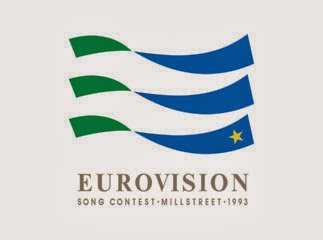
Eurovision 1993 - Millstreet


Eurovision 1993
Millstreet


Le concours Eurovision de la chanson 1993 fut la trente-huitième édition du concours. Il se déroula le samedi 15 mai 1993, à Millstreet, en Irlande. Il fut remporté par l'Irlande, pays hôte, avec la chanson In Your Eyes, interprétée par Niamh Kavanagh. Le Royaume-Uni termina deuxième et la Suisse, troisième.

Suite à la chute du Rideau de fer et à la dislocation de la Yougoslavie, le nombre de pays désireux de participer au concours crût fortement. Pour la deuxième année consécutive, l’UER élargit le nombre maximum de pays participants, le faisant passer de vingt-trois à vingt-cinq. La Yougoslavie ayant été exclue, seuls les vingt-deux autres pays ayant participé à l’édition 1992 du concours obtinrent d’emblée une place en finale. L’UER décida que les trois dernières places seraient attribuées via une présélection, qui serait organisée par la télévision publique slovène : Kvalifikacija za Millstreet.
Kvalifikacija za Millstreet (en français : Qualification pour Millstreet) détient la particularité d’avoir été la toute première présélection de l’histoire du concours. Elle se déroula le samedi 3 avril 1993, à Ljubljana, en Slovénie, et se conclut par la qualification de la Bosnie-Herzégovine, de la Croatie et de la Slovénie.

L’Irlande, qui avait remporté l'édition 1992, se chargea de l’organisation de l’édition 1993.

La télévision publique irlandaise surprit l’opinion publique en décidant d’organiser le concours à Millstreet, petite ville d’à peine 1 500 habitants, située dans la campagne irlandaise, à proximité de Cork. En réalité, la RTÉ avait reçu une très intéressante proposition de la part d’un des habitants de Millstreet : Noel C. Duggan, propriétaire de la Green Glens Arena, un vaste centre équestre couvert. Duggan avait écrit aux responsables de la télévision irlandaise, la nuit même de la victoire de Linda Martin à Malmö. Cette candidature, a priori surprenante, reçut immédiatement un vif soutien des autorités et des entreprises, non seulement au niveau local, mais aussi au niveau national. 

Face à cette mobilisation et constatant que la Green Glens Arena était extrêmement bien équipée, la RTÉ retint la candidature de Millstreet, qui devint ainsi la plus petite ville à avoir jamais accueilli le concours. Pour l’occasion, la ville et l’ensemble de ses infrastructures furent rénovés.
Mais cette décision suscita une avalanche de critiques, de moqueries et de commentaires désobligeants dans les médias européens. 
Ce fut ensuite au tour des artistes participants et des délégations étrangères de se montrer mécontents du choix de Millstreet. Ils protestèrent tout d’abord d’avoir à résider à Cork et de devoir faire, chaque jour, la navette en bus et en train, jusqu’à la salle, pour les répétitions. Ils se plaignirent ensuite de n’avoir aucune occupation pour se distraire, durant les périodes de repos.

Vingt-cinq pays participèrent au trente-huitième concours, surpassant ainsi le record établi l’année précédente.
La Yougoslavie, qui avait été exclue de l’UER, se retira pour ne plus jamais revenir. La Bosnie-Herzégovine, la Croatie et la Slovénie firent leurs débuts. Il n’y eut aucun retour et ce fut la dernière participation du Luxembourg au concours.
L’UER introduisit cette année-là une nouvelle règle, pour réguler le trop grand nombre de pays souhaitant participer au concours : la relégation. Désormais, les six pays terminant aux dernières places du classement final perdaient leur droit à concourir l’année suivante. Cette règle resta en vigueur jusqu’en 2004 et l’instauration de demi-finales.

Vingt-cinq chansons concoururent pour la victoire.

La chanson espagnole, Hombres, fut la toute première chanson de l’histoire du concours à faire mention explicite du mot "sexe" dans ses paroles.
La représentante belge, Barbara Dex, avait réalisé elle-même son costume de scène. Le soir de la finale, elle termina dernière mais sa prestation devint rapidement l’objet d’un culte de la part des fans du concours. 
C’est en son souvenir que fut créé en 1997, le Prix Barbara Dex qui récompense pour chaque édition, le concurrent le plus mal habillé.

La représentante irlandaise, Niamh Kavanagh, avait déjà remporté en 1991, un Grammy, pour sa contribution au film The Commitments d’Alan Parker. 
Lors de la finale nationale irlandaise, elle s’était disputée avec sa mère, pour avoir porté un pantalon. Le soir du concours, elle se décida donc pour une jupe. 
Elle était alors toujours employée à l’Allied Irish Banks et dut demander un congé spécial. Pour l’encourager, ses employeurs achetèrent une page de publicité dans les quotidiens irlandais du samedi, qui lui promettait un congé pour le lundi suivant, si elle remportait le concours.

The Eurovision Song Contest 1993 was the thirty-eighth edition of the competition . It took place Saturday, May 15, 1993 in Millstreet , Ireland. It was won by Ireland , the host country , with the song In Your Eyes , performed by Niamh Kavanagh . UK finished second and Switzerland third.

Following the fall of the Iron Curtain and the collapse of Yugoslavia , the number of countries wishing to participate in the contest grew strongly . For the second consecutive year , the EBU expands the maximum number of participating countries, the passing twenty-three to twenty-five . 
Yugoslavia were excluded , only twenty- two other countries that participated in the 1992 edition of the contest immediately obtained a place in the final . The EBU decided that the last three places would be allocated via a preset, which is organized by the Slovenian public television : kvalifikacija za Millstreet .
Kvalifikacija za Millstreet (in French : Qualification for Millstreet ) holds the distinction of being the first screening of the history of the contest . It took place Saturday, April 3, 1993 in Ljubljana , Slovenia, and concludes with the qualification of Bosnia - Herzegovina , Croatia and Slovenia .

Ireland , who won the 1992 edition , undertook the organization of the 1993 edition .

The Irish public broadcaster surprised the public by deciding to hold the contest at Millstreet , a small town of just 1,500 inhabitants, located in the Irish countryside , near Cork. In reality, RTÉ had received a very interesting proposal from one of the inhabitants of Millstreet : Noel C. Duggan , owner of the Green Glens Arena, a large covered riding school. Duggan had written to the officials of the Irish television on the night of the victory of Linda Martin in Malmö. This application, a priori surprising , immediately received strong support from the authorities and businesses, not only locally, but also nationally.
Faced with this mobilization and noting that the Green Glens Arena was extremely well equipped, RTÉ kept the candidacy of Millstreet , who thus became the smallest city ever to host the competition. For the occasion, the city and all its facilities were renovated .
But the decision provoked an avalanche of criticism, ridicule and derogatory comments in the European media .
It was then the turn of the participating artists and foreign delegations to show dissatisfaction with the choice of Millstreet . They protested at first to have to live in Cork and have to do every day , the shuttle bus and train up the room for rehearsals . They then complained of having no occupation for entertainment during rest periods .

Twenty-five countries participated in the thirty-eighth competition , surpassing the record set the previous year.
Yugoslavia, which was excluded from the EBU , retired , never to return. Bosnia - Herztheir debut . There was no return and that was the last of the Luxembourg participation in the contest.
The EBU introduced this year a new rule to regulate too many countries wish to participate : relegation. Now , the six countries ended the last places in the final standings lost their right to compete the following year. This rule remained in force until 2004 and the introduction of semi-finals.

Twenty- five songs competed for the win.

The Spanish song Hombres was the first song of the history of the competition to explicitly mention the word "sex" in his words .
The Belgian representative , Barbara Dex, had made her own stage costume . The night of the final , she finished last but his performance quickly became a cult by the fans of the contest. It is in his memory that was created in 1997 , the Barbara Dex Award, which rewards for each edition , the contestant worst dressed .
The Irish representative , Niamh Kavanagh, had already won in 1991, a Grammy for his contribution to the film The Commitments Alan Parker . When the Irish national final, she had quarreled with his mother for wearing trousers . The night of the contest, it was therefore decided to skirt.
She was always used in Allied Irish Banks and had to ask for special leave. To encourage him , his employers bought a page of advertising in the Irish daily from Saturday , which promised to leave the following Monday , when she won the contest.

Country
Singer(s)
Entry
Points
1.
Ireland Niamh Kavanagh In Your Eyes
187
2.
United Kingdom Sonia Better The Devil You Know
164
3.
Switzerland Annie Cotton Moi, Tout Simplement
148
4.
France Patrick Fiori Mama Corsica
121
5.
Norway Silje Vige Alle Mine Tankar
120
6.
Netherlands Ruth Jacott Vrede
92
7.
Sweden Avingarna Eloise
89
8.
Malta William Mangon This Time
69
9.
Greece Katerina Garbi Ellada, Chora Tou Fotos
64
10.
Portugal Anabela A Cidade Ate Ser Dia
60
11.
Spain Eva Santamaria Hombres
58
12.
Italy Enrico Ruggeri Sole D'Europa
45
13.
Iceland Inga Þá Veistu Svarið
42
14.
Austria Tony Wegas Maria Magdalena
32
15.
Croatia Put Don't Ever Cry
31
16.
Bosnia-Herzegovina Fazla Sva Bol Svijeta
27
17.
Finland Katri-Helena Tule Luo
20
18.
Germany Münchner Freiheit Viel Zu Weit
18
19.
Cyprus Zymboulakis & Van Beke Mi Stamatas
17
20.
Luxembourg Modern Times Donne-Moi Une Chance
11
21.
Turkey Burak Aydos Esmer Yarim
10
22.
Denmark Tommy Seebach Band Under Stjernerne På Himlen
9
22.
Slovenia 1X Band Tih Dezeven Dan
9
24.
Israel Lahakat Shiru Shiru
4
25.
Belgium Barbara Iemand Als Jij
3


Winner 1993 - Irlande - Ireland


Archives du blog

Visiteurs

Contact:

Ma photo
France
stefbz1966@orange.fr